 Published by Sue Johns-Chapman
Published Date 25.08.2026
Published by Sue Johns-Chapman
Published Date 25.08.2026 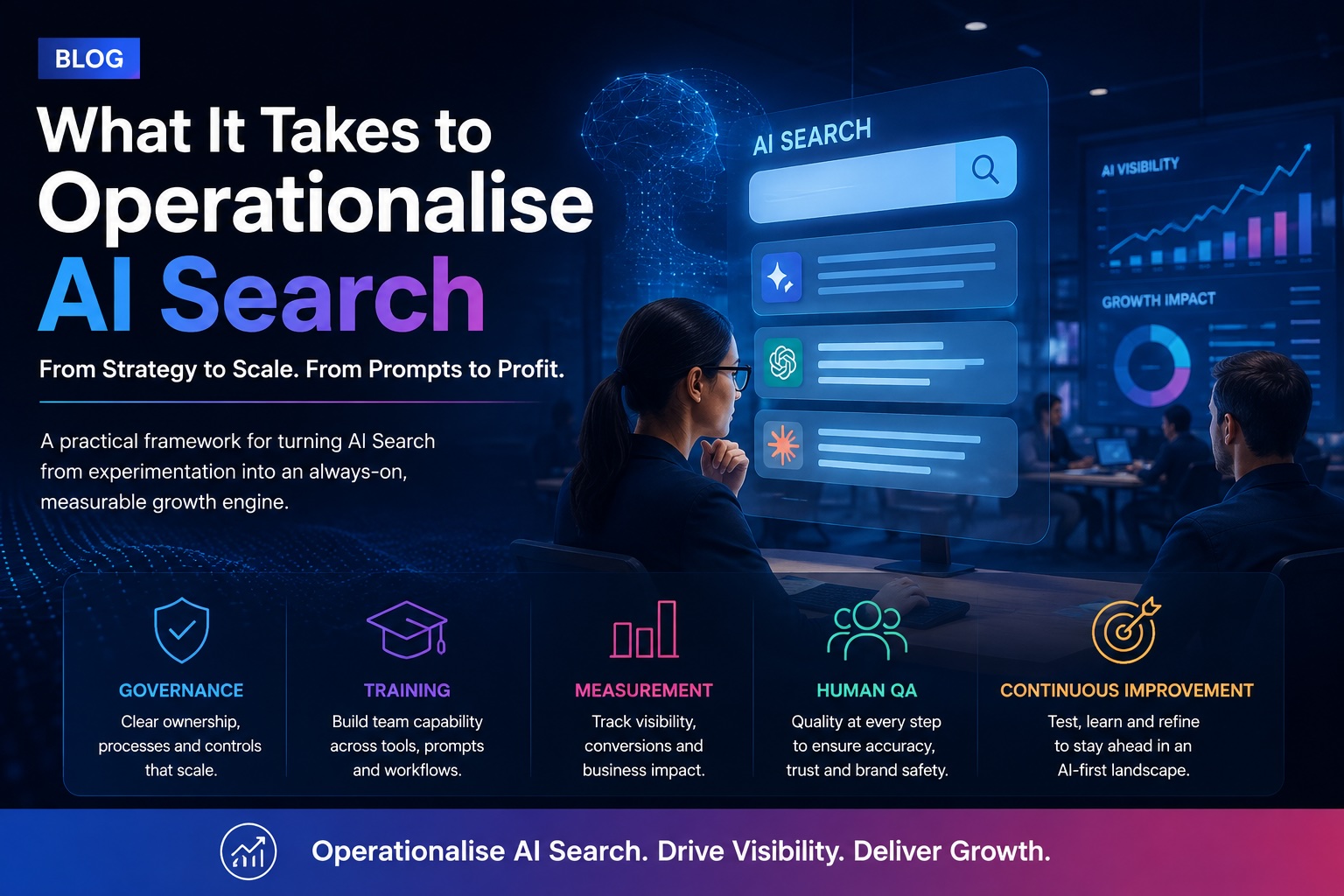
By Siddhesh Jaitapkar, Vice President – International Business & Growth, Savit Interactive
SEO gets declared dead about once every eighteen months. It survived the shift from keyword density to intent, from ten blue links to snippets and local packs, from clicks to zero-click. Each time the work did not vanish. It got broader.
What is happening now feels like more of the same in one sense and genuinely different in another. Discovery is moving beyond the traditional results page. Google is increasingly answering queries through AI Overviews and AI Mode, while people are also putting longer, more contextual questions to ChatGPT, Gemini and Perplexity. That much is real. What nobody can honestly tell you yet is exactly how the third-party assistants decide what to cite, and anyone claiming certainty about it is worth treating with suspicion.
The more useful question is a less glamorous one. When 50-plus SEO specialists work across more than 250 websites, how do you bring AI into the work without the quality quietly coming apart? For a large agency that is the real problem. Not whether AI is powerful, but whether it is consistent.
One understandable response inside a large agency is the innovation lab: take five sharp people, give them room to experiment, keep the work away from live delivery until it feels proven. It looks responsible. The trouble is that the learning can stay trapped inside that group. The other forty-five keep working the way they always have, and the gap between what the agency can do and what it actually does across every account widens each month rather than closing.
So we did the harder thing. We treated AI as an operating-model change, not a tooling one, and rolled it into delivery rather than fencing it off.
The risk with AI in a large agency is not that it flops. It is that it works unevenly. One person writes a good prompt and saves an hour. Another pastes something into a public model they should not have. A third ships a paragraph that reads well and is simply wrong. On a single website that is a mistake you catch. Across a couple of hundred it is a pattern with your name on it.
That is why the starting point was governance rather than speed, which is not the fun order to do it in. Before anyone was trained to work faster, we agreed what people were not allowed to do: how AI could be used, how client data had to be handled, what always required a human check. We built shared prompt frameworks for each function, so thirty or forty people worked from a common foundation instead of inventing forty private methods. And one rule has not bent since: AI can research, sort, draft and surface patterns, but it does not get the final say. A person owns whatever goes to the client.
Healthcare is where that rule stops being abstract. A good part of our international work is SEO for dental and clinical practices in North America, and there the limits of AI show up immediately. A model’s output is not publishable just because it sounds authoritative. Accuracy matters, clinical sensitivity matters, the client’s own guidance matters, and a person has to sit between the model and the patient reading the page. That is not a compliance framework we are claiming. It is the plain reality of the work.
It is also worth being precise about what is actually known here, because the industry conversation often runs ahead of the evidence. For Google’s own generative features, the fundamentals are less mysterious than the noise suggests. Google states that established SEO best practices still apply because AI Overviews and AI Mode are rooted in its core Search ranking and quality systems. It also explicitly says there is no need for special tactics such as llms.txt files, AI-specific markup or content chunking for Google Search. With third-party assistants such as ChatGPT and Perplexity, more caution is warranted. We treat clean architecture, genuine expert content and clear structure as sensible foundations, not as a proven formula for citations.
Training turned out to be the part that is easy to underestimate. Handing people a login does not create capability. We trained 31 of our SEO delivery team specifically on governed AI and LLM workflows, and the point was never prompt tricks. It was teaching people where the model helps, where it fails, and how to tell one from the other.
The clearest change is in research. The team still asks what a customer types into Google. Now they also ask what that customer would say to an assistant first, in a full sentence, before reaching a search engine at all. A product page can be perfect for a transactional keyword and still give a generative system nothing to understand the brand by. So the work leans more on questions, comparisons and structure now, alongside the keyword targeting, which has not gone anywhere.
Measurement is where it pays to claim only what is visible. We track referral traffic from generative platforms, because that is one of the few AI-search signals that shows up in analytics rather than being inferred from a screenshot of a single prompt. For one ergonomic-furniture eCommerce client, referral sessions from ChatGPT rose from 202 to 1,516 across the comparison period. That interests me more than a brand appearing for one carefully chosen prompt, because it is observable user behaviour in the data. Whether it maps cleanly to incremental revenue is a separate attribution question, and we are still working through that one honestly.
None of this is solved. Savit has not figured out AI search, because nobody has. But the shape of the answer seems clear enough. For a large agency it will not be the cleverest lab. It will be the boring-sounding combination: written standards, real training, measurement you can defend, and a human on the hook for every output.
The tools will change faster than any process document we write. The job is to build an organisation that can change with them without making the client pay for our learning curve. For a large agency, that may turn out to be the real AI advantage.
Savit Interactive have been shortlisted for Best Large SEO Agency at the US Search Awards 2026
About the author

Siddhesh Jaitapkar is Vice President – International Business & Growth at Savit Interactive, an SEO-led search and digital performance agency managing 250+ websites across India and international markets. With more than nineteen years of experience across SEO, digital operations and international delivery, he has led Savit’s SEO delivery, governance and adoption of AI-assisted search workflows.